How to Make Image Occlusion Flashcards for Anatomy, Biology, and Diagrams
Learn when image occlusion works, how to make better cards, and how to avoid memorizing diagrams without understanding them.
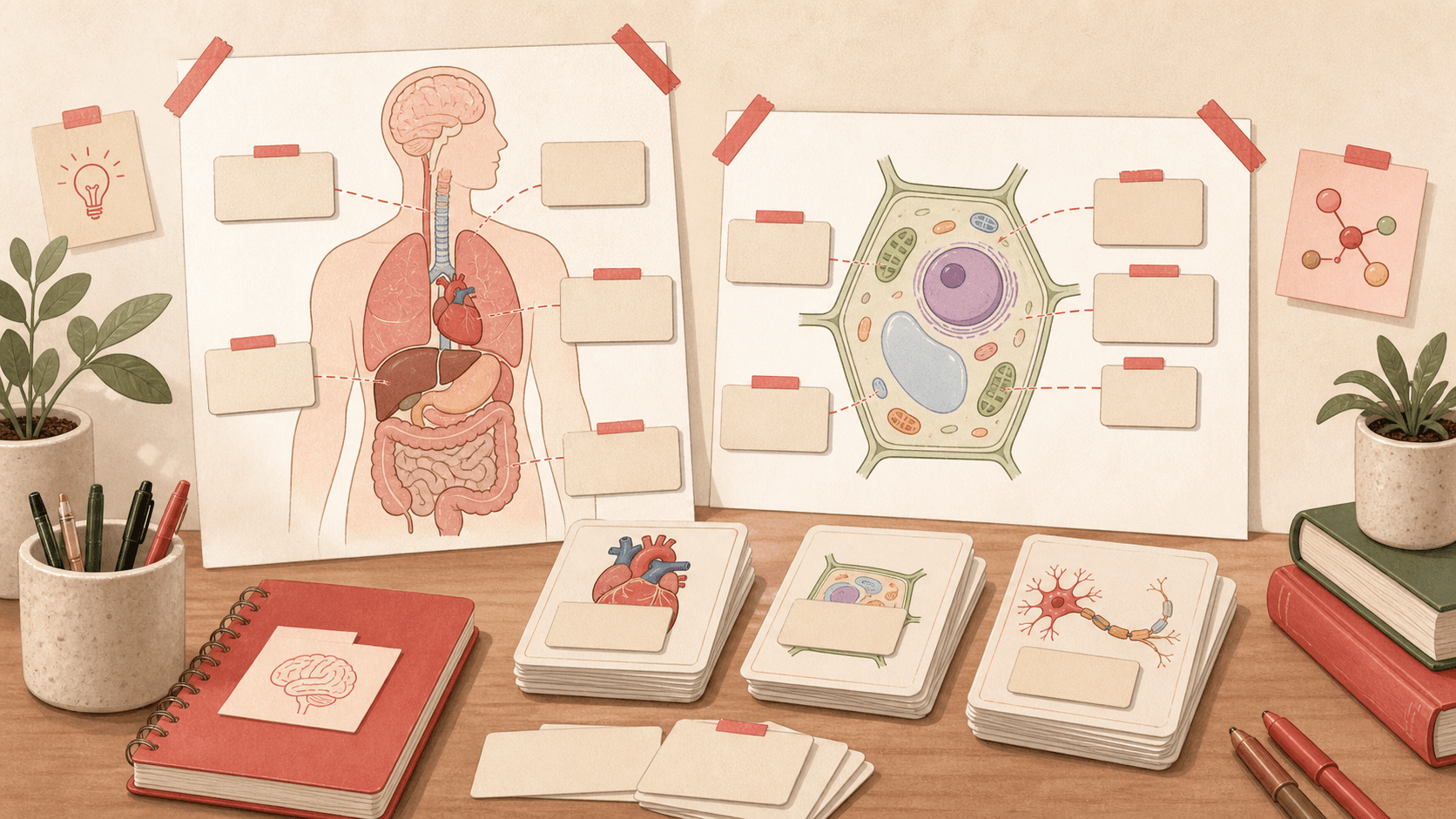
Image occlusion flashcards hide part of an image so you can recall the missing label, structure, or step. They are especially useful for anatomy, biology, maps, circuits, and process diagrams.
The trick is to use occlusion for visual recall while still learning what the parts mean.
Choose images that teach relationships
A good occlusion image shows how parts relate to each other. A bad one is just a wall of labels.
Before hiding anything, ask what the diagram is supposed to explain. Then occlude the parts that help you test that explanation.
Hide one idea at a time
If a card hides ten labels, you are making a memory dump. Keep each prompt focused enough that you can answer quickly and grade it honestly.
For complex diagrams, make several cards from the same image instead of one overloaded card.
Add a meaning prompt when labels are not enough
For anatomy, naming a structure may not be enough. Add a follow-up prompt like 'What does this structure do?' or 'What happens if it is damaged?'
For processes, ask what comes before and after the hidden step.
Review visually and verbally
Use image occlusion for location and recognition, then use regular cards or quiz questions for explanation.
Combining visual and verbal recall makes the diagram more useful outside the exact image you studied.